Sunday, July 12, 2009

Bit of watercolor doodling

Another use for 3X5 index cards: quick watercolor doodles drawn with a waterbrush and some watercolor pans.
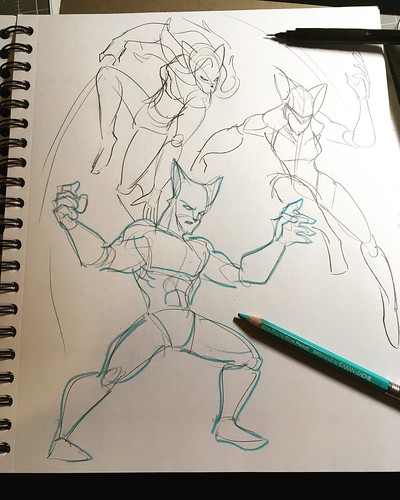
Just for fun decided to color this page of graphite doodles with a few washes of Faber Castell Albrecht Durer aquarelle sticks using a handy medium Niji waterbrush.

Saturday, July 11, 2009

Tons of sketching practice for under a buck - keep on drawing grasshoppers!

With a handful of 4" X 6" index cards and any pen or pencil, you can make the most of any idle time and get tons of doodling and sketching practice. These sample sketch cards were done at a Books-a-Million bookstore and a Target food court. Occasionally you can draw inspiration from people passing by, and make observation sketches and quick notes of the subtle differences among the many facial and body types in existence. The beauty of this particular format is that you can crank out many practice doodles in a short time uninhibited by the inexpensive nature of the support, for the packs of 100 blank index cards tend to retail for under a dollar at most places and each card doodle can be completed in a few minutes. Remember the big secret to drawing better: "the more you practice, the faster your drawing skills will improve".


Friday, July 10, 2009

Maped Tip Top Pencil sharpener + Eraser review

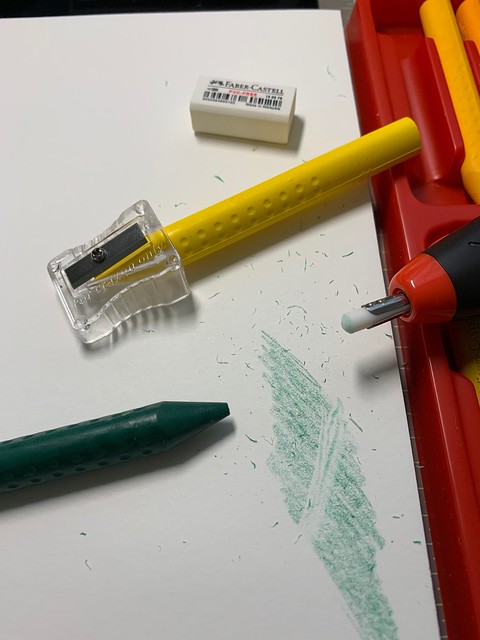
Browsing through the Target Back-to-School supplies section, I spotted these neat pencil accessories for $1.19: the Maped Tip Top cap pencil sharpener and pencil cap eraser set. They strike me as a value alternative to the Faber Castell Perfect Pencil without the extender function. They were available in several bright colors, but I naturally picked the yellow orange one to match my Maped Zenoa eraser.
When attached to the back of the pencils, the cap sharpener and cap eraser allow the pencils to be clipped to a sheet of paper. Can't imagine this to be a particular useful function, but thought to mention it since this feature is highlighted on the back of the packaging card.
Both accessories fit nicely as pencil toppers on the Mitsubishi Hi-Uni and Mitsubishi Unistar pencils.
Time to test the effectiveness of the cap eraser on this HB graphite doodle.
The cap eraser works quite nicely though it tends to get soiled fairly easily as shown by the graphite smudges on its side.
Tested the new sharpener blade sharpening a few Caran D'Ache Pablo colored pencils and a couple of graphite pencils.
The cap sharpener yields some nice sharp pencil points and can effectively double as a point protector.
I am pretty happy with the initial performance of these inexpensive pencil accessories and have made a place for both of them in my premium graphite pencils case.

Wednesday, July 8, 2009

Coloring cartoon sketches with watercolor pencils step-by-step

For one of the initial tests of my new Uni-ball Watercolor Pencil set, I decided to do a step-by-step demonstration of coloring a waterproof sketch with watercolor pencils. The Cretacolor leadholder loaded with the oil-based Nero lead was used to sketch this whimsical picture of two jungle animals-costumed characters on a Moleskine watercolor sketchbook, and the set of watercolor pencils was used to quickly color it just like you would using regular colored pencils. The Nero lead was chosen because it does not smear as much as soft graphite pencil, and it behaves more like an oil-based black colored pencil. It did stain the tips of the watercolor pencils, so I was careful to avoid touching the Nero black outlines while coloring with the Uni watercolor pencils.
For the initial flat coloring is not necessary to saturate the outlines with the dry watercolor pencil marks since the steady flow of clean water from the waterbrush will blend and spread the pigment through each section of the illustration.
Close up of the loose dry coloring of the costumed girl's head.

I often find it easier to start at the head and work my way down. The yellow and ochre parts of the face, beak, and wings were moistened first. Then the pink and orange of head and upper body parts were further defined followed by the blue head feathers.
The waterbrush was used to selectively blend the dry colored pencils marks with water. It is more efficient to start from the lightest color and work towards the darker ones, so that the brush tip does not require too much cleaning between color changes.
This compact set up can work in very small spaces like this food court table. Taking a few minutes to stretch my legs and allow the initial flat coloring to dry a bit so later color applications will not run into each other uncontrollably.
Picking up pigment directly from the point of the Canary Yellow watercolor pencil with the moistened waterbrush to add some shading to the beak and wings. Watercolor pencils are quite a versatile medium functioning both as effective drawing tools as well as a ready source of watercolor paint. A few darker shades were added in a similar manner to add volume and texture to the initial flat coloring.
Finished illustration.
Final reminder tip: Use a napkin or paper towel to wipe the waterbrush clean between color changes and to wipe dry moistened pencil tips to prevent them from crumbling and weakening after using the pencils as watercolor pans.

Monday, July 6, 2009

The Worther Shorty pencil is an ideal field sketching tool

These are some of my preferred graphite tools that I like to take with me to do the sketching demonstrations for my cartooning lessons. It is nice to have a wide range of options in lead sizes and graphite grades to work with any kind of support that I might find in a classroom. The main advantages of the clutch-type leadholders are that they maintain a constant length and do not require constant sharpening (especially if you are careful to periodically rotate the pencil as you draw). If they ever get too blunt, there are also specialty leadpointers available to restore the sharp points of the thick graphite leads (like the red KUM model shown in the photo above). The Worther Shorty is my favorite choice for sketching on-the-go for its sturdy, compact, and lightweight design. Its 3.15 mm thick 7B lead resists breakage while still producing a nice range of grays with ease. I find it extremely comfortable to hold and use for extended periods. For one of my most compact sketching kits, I tend to take the Shorty and a small Moleskine sketchbook in the pockets of my cargo pants. The only real problem I have with it is that its 3 mm refills tend to be rather hard to find. Usually the tubes of 3 mm leads can only be found online, and often they are out-of-stock when you need them.
Now that I managed to get some more spare 3 mm 7B graphite leads for it, the Worther Shorty has regained its regular spot in my daily take-along sketching kit.
Sketches drawn in blank and gridded 4"X6" index cards.
The Worther Shorty pencil and a handful of 4"X6" blank index cards also make a very efficient field kit for doodling and sketching anywhere.

Sunday, July 5, 2009

Shopping for art Supplies in Miami

While I do get quite a few art supplies from several online sources, I do love visiting actual brick and mortar stores to check out the full range of offerings if given the option (sadly there is not a single well-stocked art supplies specialty store in the Naples area). Had to drive dad to the Miami Airport earlier today, so I was lucky to fit a couple of interesting stops after dropping him off. Finally was able to check out the enormous and well-stocked Jerry's Artarama Miami store. Got some hard-to-find drawing leads for my 5.6 mm Cretacolor leadholders and my Worther Shorty pencil. As far as I know, this might be the only brick and mortar store that carries the full range of Cretacolor 5.6 mm drawing leads 6-packs. The store is very well-organized, and it is a pleasure to stroll through the aisles loaded with a wide variety of quality art supplies neatly stacked and clearly priced. This was the first time, I was able to appreciate the size and heft of the Caran D'Ache Neocolor II full boxed set of 126 watercolor crayons with extra accessories and the wooden box set of all 72 Derwent Inktense watercolor pencils. If you happen to be in the neighborhood, it is well worth a visit.

On the way back to Naples, I stopped at an enormous Office Depot store in Hialeah right off Palmetto Hwy - 826. With their heavily discounted Red Tag Sale items, I managed to stock up on tons of sketching paper and blank index cards for drawing lesson points for my students. Word to the wise, stop for a few minutes to check for good deals if you happen to drive by one of their stores.

Thursday, July 2, 2009

How to Draw Cartoon Face portraits

First a disclaimer: this is not the only way to draw peoples' faces in a cartoony style. This is simply the result of my reading many "How to Draw" books and my ongoing practice at developing a systematic approach to cartoon portraits. Don't expect to get good at drawing in an unrealistic short time. Just because a coach might be able to show you how to kick a ball and the basic rules of football on your first meeting, it doesn't mean that you will become a star player overnight. Like anything worth doing, improving your drawing skills will take commitment and lots of practice. All the following sample sketches were drawn with pencils on 80 lb sulphite drawing paper.Fill tons of sketch pages with all the possible symbols you might want to use to represent the main facial features. The left column shows the sequence I usually follow to construct eyes with a single reflective spot indicating the direction of the light source (sun or electrical lighting). The examples in the bottom left corner show the different approaches for depicting light colored eyes and dark colored eyes. The middle column shows different symbols for drawing noses, and the right column shows different mouth symbols.
When approaching a subject for a cartoon portrait try first to figure out the general shape of the face: Does the model's face look more like a circle? a square? or an inverted triangle? Then loosely sketch the outline of the face, so that you can add the cross guidelines that will help place the different facial features. Observe your model carefully, and take note of the relative distances among the facial features: are the eyes close together or far apart? What's the distance between the eye line and the bottom of the nose? how wide is the mouth? Do the corner of the lips line up with the pupils? In other words, you are figuring out how the model's unique characteristics compare to the average head symbol in your mind. The general idea in caricature portraits is to exaggerate the sitter's more distinctive traits in order to achieve an immediately recognizable likeness. Thus if someone has small eyes, you might tend to draw them smaller to emphasize that fact. If someone has a big nose, you might draw it larger. Yet, I would recommend exercising some editorial restraint and err on the side of kindness by striving for pleasing attractive drawings rather than wildly exaggerated cartoons poking fun at the appearance of your models. Think of celebrating your models' inner child and beauty rather than thoughtlessly highlighting what they might perceive as their imperfections.
Trying out different hair styles and viewing angles.
Putting it all together by doodling a few more random faces.
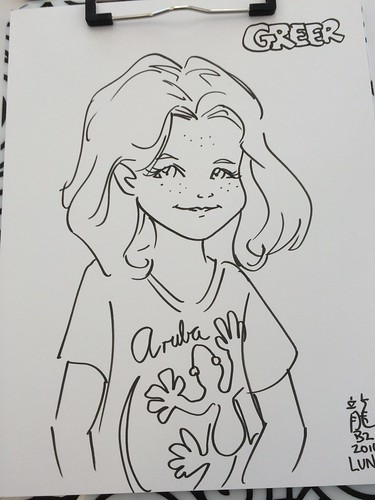
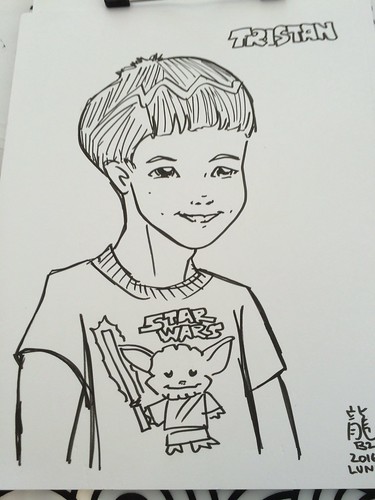
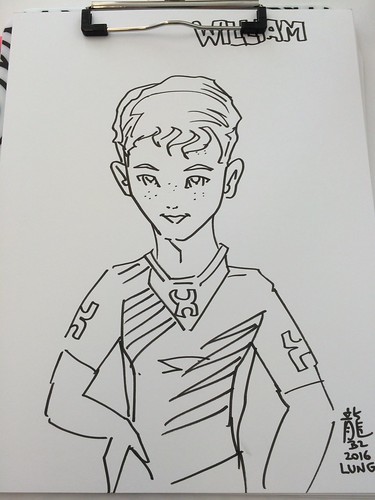
Trying to capture a likeness by concentrating on details like the stylized freckles on the cheeks, the shape of the head, and the outline of the hair line framing the face (bottom left corner).

Tuesday, June 30, 2009

Local shopping tip and sample field sketching kit

Time to check out your local Office Depot stores' clearance sections for some treasures. Some recent additions include assorted packs of index cards and holders that work quite well as portable sketching kits: take a handful of cards along with a pencil, and you can sketch anywhere without spending much in the materials used for your practice doodles and quick studies.
"500 blank cards for 83 cents" is a great deal that sure beats a small Moleskine sketchbook for ten bucks anyday. The Pentel Outline green/silver marker pen, refillable Koh-I-Noor Rapidograph 0.25 mm technical pen, and Staedtler Mars 0.25 & 0.3 mm technical pen refills were reduced to under 50 cents each (which is about 90% in savings from their retail prices).
Found this neat sketching bag (originally a German map case) in a recent trip to an Army Surplus store, proving that suitable art supplies can sometimes be found in the unlikeliest of places with just a little ingenuity. Its front pockets can hold a few wooden pencils, ruler, and sharpener while the two interior large compartments comfortably hold a Handbook 5" X 8" sketchbook and a tin of Caran D'Ache Neocolor II watersoluble crayons with a couple of waterbrushes. This light and compact set up could easily be taken along on field sketching trips and sketchcrawls.

Wednesday, June 24, 2009

Initial Session with the Mustangs group at the Boys & Girls Club

The students today really impressed me with their talent and enthusiasm.

Some of the drawings done by the Boys and Girls Club Mustangs group during the character design part of their first Manga Cartooning lesson using some index cards sketches that were provided as reference and some blank sketchboard templates for support.
Thus for their second session, I have prepared a series of Faber Castell Pitt Artist brush pen quick 3-minutes illustrations (about 19 reference doodles drawn in an hour at the food court while waiting for my color ink printer cartridge to get refilled) as examples of some of my sketching symbols from memory.

The students could use them as references to copy when they get stuck for inspiration. I suspect they might make also suitable coloring sheets.

Monday, June 22, 2009

Doodling in the waiting room at the auto shop

Always carry some art supplies with you! Had I not done so I would've wasted about an hour waiting for an oil change. With my Creative Mark 5.6 mm lead holder loaded with a sharp 4B graphite lead, I managed to fill about 9 sheets of card stock with doodles practicing my sketching symbols for a variety of cartoon subjects. Since I did not stop to sharpen the lead, lines grew increasingly thicker on the latter sketches.


Sunday, June 21, 2009

Sharpie Pen and Crayola crayons: a couple of inexpensive sketching supplies available locally

Some of the discounted supplies found on recent trips to Office Depot: large 11" x 14" Mead sketchbooks and oversize 14" x 17" Foray Marker pads for $3 each that I plan to use for in-class drawing demonstrations. They will come in handy when the limited range of expression of dry erase markers becomes an obstacle to the clear exposition of drawing tips and techniques.
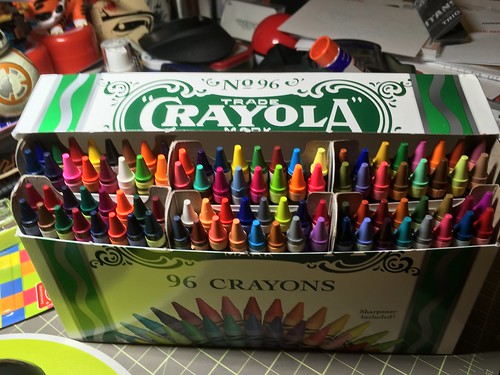
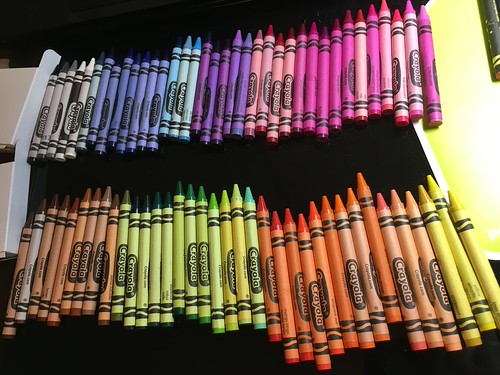
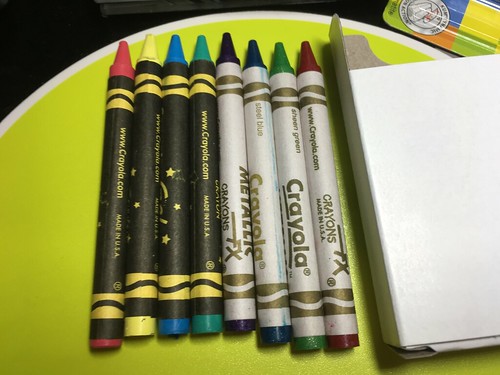
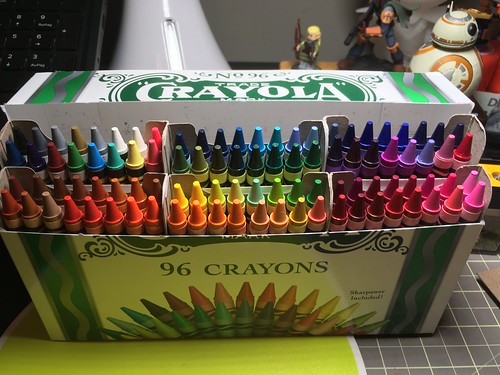
It had been a while since I actually tried using Crayola crayons for anything, but decided to test a box of 24 crayons on the Mead sketchbook paper as a potential inexpensive coloring tool for the cartooning classes. While the colors appearance on the paper is nowhere near as saturated as that of the Caran D'Ache Neocolor I wax crayons, I have to admit that for 30 cents this compact set is a pretty good value for the quick-sketching of early rough color studies.
Comparing the line quality and writing performance of several pigment liner pens of similar nib size (around 0.3 mm in diameter) on Foray marker paper, no significant difference was apparent at first glance. Unlike most of the specialized pigment liners shown, the Sharpie Pen is a fairly common find at local retailers and office supplies stores while costing the least of this bunch.
While marketed primarily as a precision writing tool, I find the Sharpie Pen quite suitable for doodling with ink. The nib feels strong and glides smoothly on both marker paper and regular copy paper leaving dark uniform lines with no bleed through. Despite some online reviews warning of poor durability (mainly paint chipping off the barrel and loosening up of the plastic cap after posting it on the back of the pen), the Sharpie Pen seems promising as a sketching tool given its initial performance and recently lowered price (found the 2-pack for $2.50 at a local Walmart Supercenter store). I just plan to either use it at home or carry it securely in pencil cases that would prevent rubbing against other tools that might cause the dreaded paint chipping. When posting the cap on the back of the pen while in-use, avoid using excessive force and do not push the soft plastic cap all the way down to prevent it from getting loose prematurely.

Saturday, June 20, 2009

Some photo reference material and templates for the Manga Cartooning class at the Boys & Girls Club (B&GC)

Normal straight on reference shot of Final Fnantasy VII Adevent Children Tifa Lockhart.
Worm's eye view of Final Fantasy VII Yuffie Kisaragi: reference shot was taken from a low angle.
Bird's eye view: reference shot was taken from above.
Just a few reference shots using these articulated Final Fantasy figures as art makinins.


Just a few 8.5" x 11" templates with digitally applied B&GC Art Lab backgrounds that can printed and used for thumbnail planning of a manga story set in a classroom.