Manga style cartooning and art supplies recommendations for kids


Mateo, my 2-year old nephew, trying out my trusty 3.15 mm Worther Shorty leadholder.
Worther Shorty + Moleskine Pocket Sketchbook = one efficient sketching kit. Even for toddlers!
Should I draw with my right hand?
Hmm, or is it better when using my left hand?
Trying out my travel set of Uni watercolor pencils.
Right-handed?
Or lefty? Time will tell.
Trying out a 0.7 mm Pentel Graph Gear mechanical pencil on a pocket Moleskine sketchbook.
Figuring it out how the 3.15 mm graphite lead loads into the Worther Shorty leadholder. I find that with close supervision, most of my young nephews and nieces can safely enjoy the opportunity of trying out artist grade and grown-up sketching tools.
Since I got a couple class packs for upcoming Family Art Night activities, decided to do a quick review of the Crayola watercolor pencils. While I have not found any local brick-and-mortar retailer that carries them, they are fairly easy to find online. They are a good introduction to the advantages and range of techniques possible with watercolor pencils with a minimal investment. Watercolor pencils often feature a brush design on their barrels to highlight the water soluble nature of their leads.
Colored chart on Canson 90lb (185 gsm) watercolor paper displaying the expressive range of the set of 12 Crayola watercolor pencils: the left side of each color swatch was left dry, the middle shows how much brighter each color looks when wet, and the right side consists of the transparent color wash produced by dragging a loaded waterbrush on to the uncolored paper.
Dry sample illustration colored on white card stock with the watercolor pencils.
A large Kuretake Niji waterbrush was handy for smoothing out selected areas of dry watercolor pencil.
These Crayola watercolor pencils are versatile fun coloring tools that can be used dry and wet. They allow the precise control of regular colored pencils when sketching and drawing with them, and their dry marks readily dissolve into smooth delicate transparent color washes with the aid of a water loaded sable brush or a waterbrush. Worth trying for a creative change in your kids' art time or classroom.
Sample Zoo Town building block. We are going to have a selection of salvaged cardboard boxes along with several art supplies (paints, brushes, markers, construction paper, and glue), so that the kids can use their creativity to draw, color, paint, cut and paste according to their skill levels and build their own corner of Zoo Town. We'll also have a selection of coloring outlines of a few zoo animals on hand to help populate our cardboard Zoo Town.
Dry watercolor pencil stage.
Quick and easy "painted look" after the dry watercolor pencil marks were blended with a waterbrush.
Giraffe outline colored with Faber Castell Albrecht Durer watercolor pencils dry stage.
Holding impromptu mini contests has proven to be a good way to motivate students to generate character desings within a set time limit.
Volunteers and students appreciating the monsters/character design entries.
"Winged Pegasus" was the prize chosen by the first place winner.
"Monkey in a diaper" was the second place prize for the character design contest and drawn in color upon request with Faber Castell Pitt Big Brush Artist Pens.

Sequential art pages created by gifted student.
Colorful work done with watercolor pencils and a waterbrush.
Crayola marker sketches.
Highly naturalistic work drawn by talented class volunteer.
A few pencil sketches.
Colored character and manga comic page.
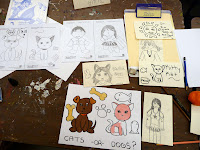
Chibi people and cats & dogs.

Colored pencil sketch of a Chibi ninja.
Pencil sketch of a Xevoz soldier action figure.
Using a Real Bug Chafer Beetle encased in resin for drawing reference.
A list with few suggestions for elements that could be included in their comic book covers.
Students hard at work.
Students with their colorful Manga comic book covers drawn with watercolor pencils.
Happy siblings with their colorful pieces.
Bit of colored pencil work.
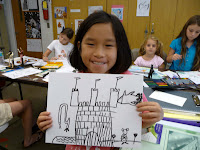
Castle drawn with Sakura Pigma Sensei pigment liner pens.
Manga covers commenting on Mickey Mouse Corp.
A young artist quite content with his piece of "Screaming Vegetables" drawn with colored markers.
Students detailed dragon sketch was drawn with a Faber Castell Pitt Artist brush pen.
1. Minimal Starter kit: handful of copy paper sheets and pen or pencil is all that’s needed to start doodling. A clipboard is handy for support and keeping sketches neatly together. A 0.5 mm mechanical pencil would be a good choice since it doesn’t require sharpening and often features a small eraser .
2. Compact Take-anywhere kit: a small 3½" × 5½" Moleskine-type sketchbook, a mechanical pencil, and a nice black gel pen can easily fit in a jacket pocket for sketching anywhere.
3. Regular field kit: a small shoulder bag loaded with a 7" × 10"-9" × 12" double wire bound Canson Field Sketchbook, a mechanical pencil, a couple of Faber-Castell Pitt Artist pens, a waterbrush, and a small watercolor crayons set can cover most situations on a moment’s notice.
4. Portable Studio: keep all options open in a messenger bag or backpack loaded with a large 9" × 12" or 11" × 14" mixed media sketchbook, favorite mechanical pencil or handful of drawing pencils, Pilot Foam eraser, set of pigment liners, pan watercolor set, waterbrush, and anything else you care to carry.